
Real World Impact

General Plan Update Equity Facilitator
Marybelle Nzegwu Tobias, Principal
Colin Miller, Senior Associate (Phase I)
Sarina Vega, Associate (Phase II)
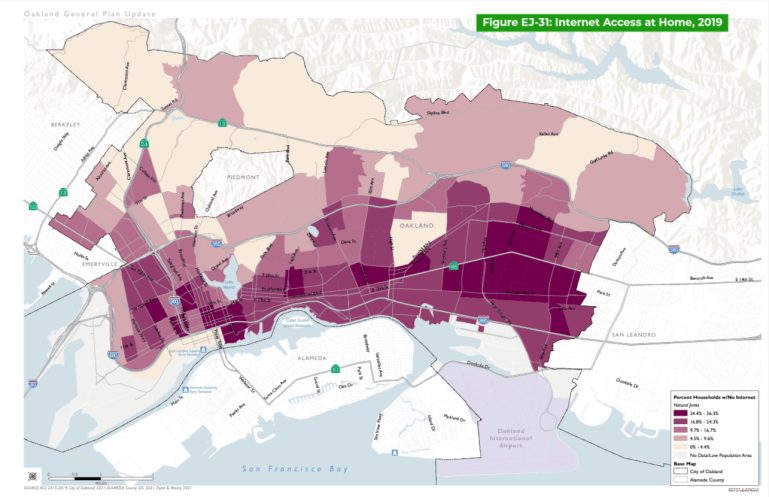
As a core partner on Oakland’s technical team, E/J Solutions ensures a firm equity foundation for the entire General Plan Update. We are conducting a groundbreaking Racial Equity Impact Analysis (REIA) for every component of the General Plan Update—from housing to infrastructure. By co-developing custom Environmental Justice Maps and embedding social justice into the city’s long-term blueprint, we are helping build a future Oakland that works for everyone.
Phase I
- Environmental Justice Communities Map with Equity Scores
- Community Engagement, in collaboration with the City’s community consultant, Deeply Rooted
- REIAs for the Housing Element, Environmental Justice Element & Safety Element
Phase II
- Equity Considerations for Options for Growth
- REIA for the Land Use and Transportation (LUTE), Open Space, Conservation, and Recreation (OSCAR), Noise, and Infrastructure & Facilities Elements
Social Equity Community Committee & Strategic Plan
Marybelle Nzegwu Tobias, Principal; Colin Miller, Senior Associate
Sarina Vega, Sylvia Escarcega, Nefertiti Altan, Aitran Doan,WeiKuen Tang, Amani Will, Associates
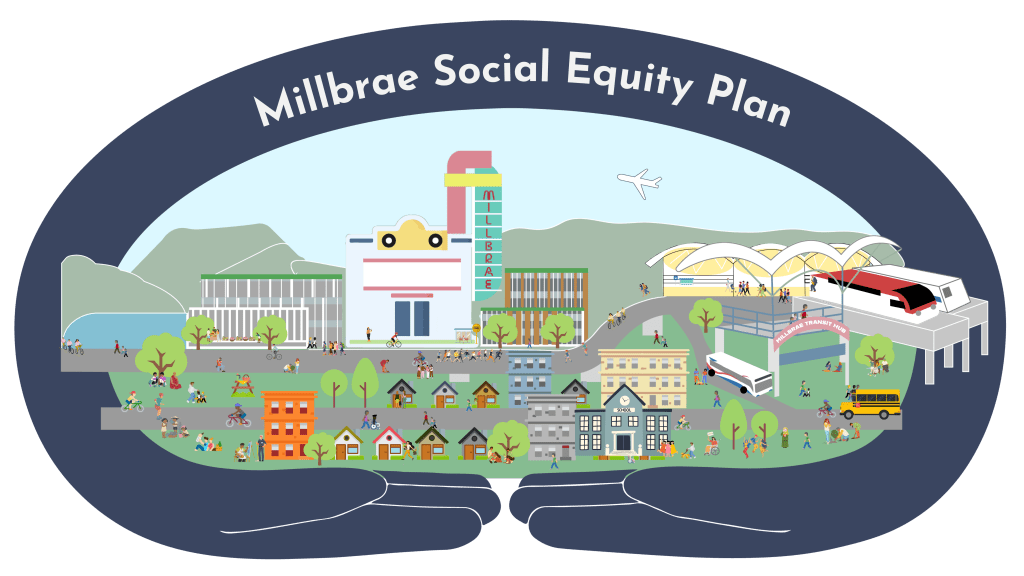
E/J Solutions worked to transform community voices into a bold blueprint for social equity and inclusion. We brought together and facilitated a 15-member Community Social Equity Committee to co-author a strategic plan covering 17 spheres of equity with measures to ensure results-based accountability. We developed custom iconography and a unique visual identity that grounds the plan’s goals in the everyday life of the community.

Building Electrification & Targeted Gas Decommissioning Focus Groups
Marybelle Nzegwu Tobias, Principal; Colin Miller, Senior Associate
Sylvia Escarcega, Nefertiti Altan, Aitran Doan,WeiKuen Tang, Amani Will, Associates

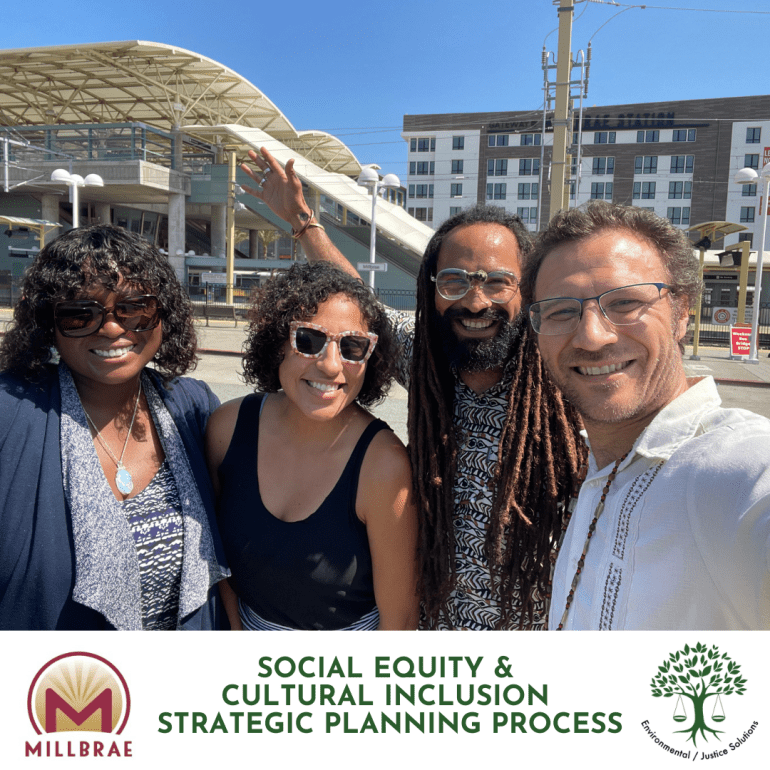
E/J Solutions spearheaded community engagement for a groundbreaking California Energy Commission (CEC) study on targeted electrification. We led three in-depth, in-person focus groups across three neighborhoods in Ava Community Energy’s (formerly EBCE) service territory to uncover real-world barriers and pathways toward targeted electrification. Our final recommendations transformed the priorities of local residents into a comprehensive equity roadmap.
The project’s final report: An Analytical Framework for Targeted Electrification

Air Pollution Community Needs Assessment, Listening Sessions & Community Air Action Plan
Marybelle Nzegwu Tobias, Principal
Colin Miller, Senior Associate
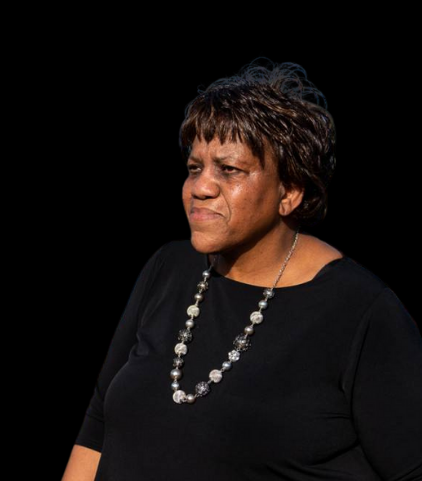
Partnering with Ms. Terrie Green and Marin City Climate Resilience and Health Justice, E/J Solutions facilitated a youth-led assessment capturing the air quality concerns of over 150 residents. After deep-dive listening sessions, we transformed this data into a Community Air Action Plan. This roadmap empowers Marin City residents to drive meaningful health improvements while ensuring the existing community remains whole and vibrant.

A People’s Vision for Food Sovereignty in the Bay Area
Marybelle Nzegwu Tobias, Principal; Colin Miller, Senior Associate
Aitran Doan, Sylvia Escarcega, Megan Mubaraki, Eva Farah, Associates
E/J Solutions led a deep-listening campaign across the nine-county Bay Area, conducting roundtables and one-on-one interviews to uncover the systemic gaps in our food infrastructure. By synthesizing community lived experience with regional data gathered by the full PFFP team, we co-created a People’s Vision for Food Sovereignty—a bold, community-backed framework for a food system that is equitable, sustainable, and rooted in justice for both consumers and farmworkers.


Equitable Lead Poisoning Prevention Policy: Racial Equity Impact Analysis
Marybelle Nzegwu Tobias, Principal
On behalf of the City of Oakland’s Department of Race & Equity, Marybelle gathered and assessed extensive data on disparities in lead poisoning and prevention efforts. By isolating geographic and demographic indicators, Marybelle developed a strategic framework to bridge equity gaps. The REIA included detailed recommendations for the development of an Equitable Lead Hazard Abatement Program for the City of Oakland and County of Alameda’s joint programmatic efforts.


CITY OF OAKLAND PRESS RELEASE Announcing Release of Report & City Council’s Approval of a new Equity-Based Lead Program (December 21, 2021)
On December 21, the Oakland City Council authorized a Memorandum of Understanding, which was also authorized by the Alameda County Board of Supervisors on December 16, 2021, allocating 60% ($14 million) of the settlement funds to the City of Oakland to fund lead poisoning prevention services within the City and 40% of the funds ($9.6 million) to fund lead poisoning prevention services within Alameda County but outside of Oakland. The City will receive 20% ($4.8 million) now to fund development of an Equity-Based Lead Program to implement the recommendations outlined in the Equity Impact Analysis.
Project Updates: Moving Toward Implementation
2024 and 2025 marked a period of intense community advocacy and technical planning to move the $14 million in settlement funds into active abatement.
- Consultant Roadmap & Pilot Launch: In late 2024, the City of Oakland secured a grant from the Partnership for the Bay’s Future to fund a two-year fellow dedicated to launching the lead hazard abatement program. Additionally, the city hired the Green and Healthy Homes Initiative (GHHI) as a technical consultant to deliver final program recommendations. Following a rigorous technical review by GHHI in mid-2025, the City of Oakland is set to launch a pilot version of the abatement program in early 2026.
- Proactive Rental Inspections (PRIP): Based on the equity principles established in the REIA, the city is now working to integrate lead abatement with a Proactive Rental Inspection Program. This shift aims to move Oakland from a “reactive” system (waiting for a child to be poisoned) to a “proactive” one that identifies hazards before exposure.
- Continued Advocacy: Principal Marybelle Nzegwu Tobias remains at the forefront of this effort, recently participating in high-profile panels like “Toxic Inaction: Addressing Oakland’s Lead Crisis” to push for the swift and equitable use of the $4.8 million currently held for program development.
- Ongoing County Support: The Alameda County Healthy Homes Department continues to provide free lead paint hazard repair grants of up to $10,000 per unit for eligible low-income properties.
In the Press
- Toxic Inaction: Oakland’s Lead Funding Languishes A deep-dive investigation by El Tímpano and the Pulitzer Center highlighting the systemic delays in lead remediation and the critical need for the equity-first approach outlined in E/J Solutions’ REIA.
- Poisoned Pipes and Painted Walls El Tímpano’s ongoing series explores the human cost of lead exposure in Oakland and follows the community’s fight to activate the $14 million in settlement funds.
- From Soil to City Hall: Putting Oakland’s Lead Problem on the Agenda A retrospective on how investigative reporting and community advocacy—featuring Principal Marybelle Nzegwu Tobias—successfully pressured city officials to prioritize lead abatement.
- Oakland Wins Grant for Equitable Housing Habitability Initiatives Official announcement of the Partnership for the Bay’s Future grant, which funded the staff capacity necessary to implement the REIA’s recommendations.
- Toxic Inaction: Addressing Oakland’s Lead Crisis Coverage of the 2025 community panel where Principal Marybelle Nzegwu Tobias shared key findings from the Racial Equity Impact Analysis with residents and decision-makers.

UC Climate Resilience Planning Initiative
Marybelle Nzegwu Tobias, Principal
Colin Miller, Senior Associate
E/J Solutions co-developed a step-by-step framework for UC campuses and medical centers detailing how to accomplish climate resilience planning centered in Justice, Equity, Diversity, and Inclusion. Marybelle Nzegwu Tobias and Colin Miller co-authored the framework with Aryeh Shell of Thrive Consulting and Janika McFeely, Robin Hawker, and Lisa Westerhoff of Integral.

E/J Solutions also facilitated high-impact workshops for all 17 UC locations that successfully transitioned the system from theory to practice. (10 Campuses, 5 Medical Centers, UCOP, and ANR). UC staff worked with community leaders to identify local vulnerabilities and potential actions for improving resilience. This work has directly resulted in the creation of site-specific toolkits—such as the UCI Health Community Engagement Strategy and the UCSF Health Resilience Toolkit—which integrate climate resilience into emergency management and patient care.

Connected Communities Focus Groups
Marybelle Nzegwu Tobias, Principal; Colin Miller, Senior Associate
Aitran Doan, Tran Lam, Associates
Hosted focus groups with struggling utility customers in Alameda County in English, Spanish, Vietnamese and Cantonese. Prepared detailed program recommendations based on our findings.


Community Climate Solutions: Equity & Engagement Advisor
Marybelle Nzegwu Tobias, Principal
Developed community listening sessions for San Leandro residents to inform local, regional, and state climate policy.
Oakland 2030 Equitable Climate Action Plan
Equity Facilitator Team Lead
Marybelle Nzegwu Tobias, Principal
Colin Miller, Senior Associate (Coordinator – Oakland Climate Action Coalition)
David Jaber, Director of Optimization – Blue Star Integrative Studio


E/J Solutions led the City of Oakland’s Equity Facilitator team, ensuring that the city’s 2030 Equitable Climate Action Plan (ECAP) was built from the ground up by frontline communities. Over 5,000 Oaklanders participated in our robust and equitable community engagement process to develop community priorities for the plan.
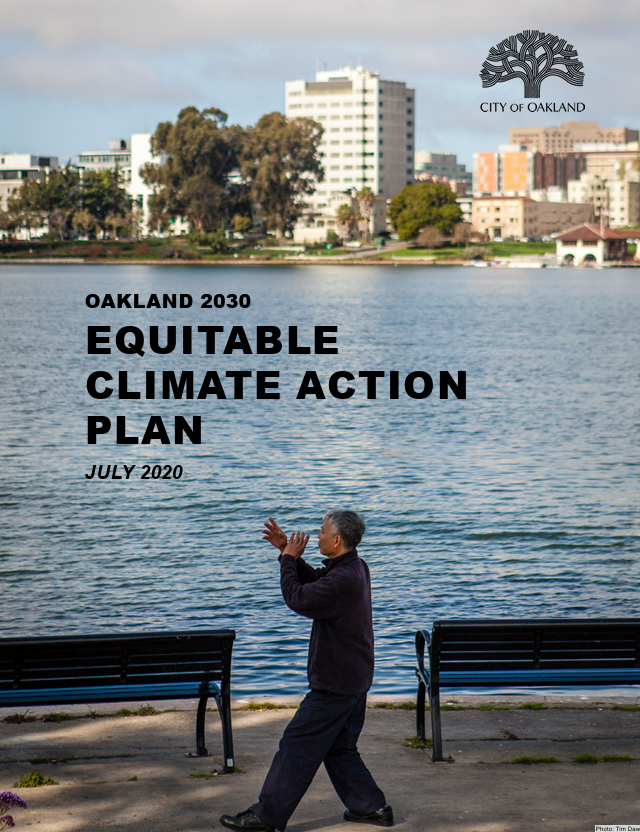
“The ECAP represents a new way of truly embedding equity… It addresses broader social challenges like racial inequity and housing insecurity while pursuing carbon neutrality.” — Daniel Hamilton, Chief Resilience Officer, City of Oakland
We co-developed the plan’s framework and authored the Racial Equity Impact Assessment and Implementation Guide (REIA), which now serves as the city’s blueprint for equitable climate action implementation. The ECAP and REIA were unanimously adopted by Oakland City Council on July 28, 2020.
CORE PROJECT ACTIVITIES
Resilience Building: Focused on creating meaningful benefits for frontline communities through climate actions that reduce poverty and environmental harm through housing security, green job pathways, and community-centered infrastructure.
Equitable Engagement: Facilitated a deep, community-led process , co-facilitated by a Neighborhood Leadership Cohort of 23 residents. Developed Oakland 2030 website, which hosted our climate action survey, included a portal to leave comments directly on the draft plan, and shared announcements for upcoming events, including Climate Equity Work Days co-hosted by local Oakland nonprofits and community groups.
Policy Integration: Ensured that all 40 plan actions—from buildings to zero waste—function as an effective equity strategy to reverse racial disparities.
Racial Equity Impact Assessment: Gathered and assessed data on disparities in Oakland to identify the City’s frontline communities and provided detailed recommendations for maximizing benefits to frontline communities throughout Plan implementation. For example, by identifying the areas where Childhood Asthma Emergency Visits and Housing Displacement were the highest, we successfully advocated for the ECAP to prioritize: electrification of heavy-duty trucks on the I-880 corridor and mandatory anti-displacement protections for all new green-infrastructure zones.
Created Oakland 2030: Equity at the Center, a short popular education video about the REIA (below).
IN THE PRESS
EAST BAY EXPRESS Climate Change & Social Change by Jean Tepperman
SAN FRANCISCO CHRONICLE How climate change activists are adapting to the pandemic by Taylor Kate Brown
OAKLAND NORTH New climate action plan details city action to reduce greenhouse gas emissions by Isabel Lyndon
THE AMERICAN PROSPECT A Green New Deal for Oakland by Julian Brave Noisecat
PO PEOPLE’S REVOLUTIONARY NEWZ HOUR Interview with Host Lisa Tiny Gray-Garcia
PROJECT IMPLEMENTATION & IMPACT
The ECAP and REIA are guiding several high-impact, multimillion dollar initiatives that prioritize Oakland’s most burdened neighborhoods.
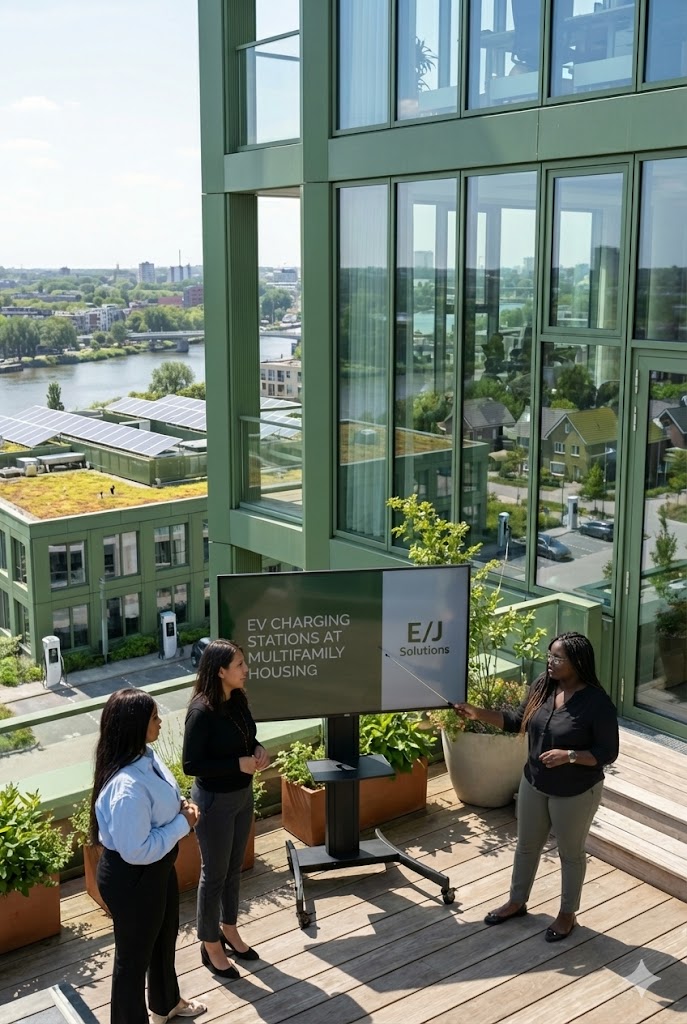
| Clean Mobility – Ava Charge Network | In November 2025, the City and Ava Community Energy launched the Ava Charge station at City Center West Garage. The largest non-Tesla fast-charging station in Northern California, it and future Ava Charge stations, specifically target locations accessible to renters and residents of multi-family housing who lack home charging access. |
CalEnviroScreen: A Critical Tool for Achieving Environmental Justice in California
Marybelle Nzegwu Tobias, Principal
Marybelle Nzegwu Tobias co-authored the environmental justice policy manual with the California Environmental Justice Alliance’s Tiffany Eng, Green Zones Program Manager and Amy Vanderwarker, then Senior Program Strategist. The manual advised policymakers on how to use CalEnviroScreen to create equitable policies that protect overburdened communities and direct much-needed resources to disadvantaged areas.
Rose Foundation for Communities and the Environment
Marybelle Nzegwu Tobias, Principal
Member, Board of Directors
Member, California Environmental Grassroots Funding Board
Oversee foundation governance and award small grants for community-based environmental science, education, and advocacy.


West Oakland AB 617 Community Action Plan: Owning Our Air – Steering Committee Co-Facilitator
Marybelle Nzegwu Tobias, Principal
Co-facilitated a consensus-based, community-led planning process that resulted in the development of the Owning Our Air plan, which seeks to reduce air pollution disparities in West Oakland.
 E / J Solutions